
When a cleaning drone is connected to both power and water lines at the same time, the ground system supplies it with continuous resources while also imposing two distinct kinds of external load. The cable and the water hose differ in weight, stiffness, and dynamic behavior, and cannot simply be treated as a single connection line.
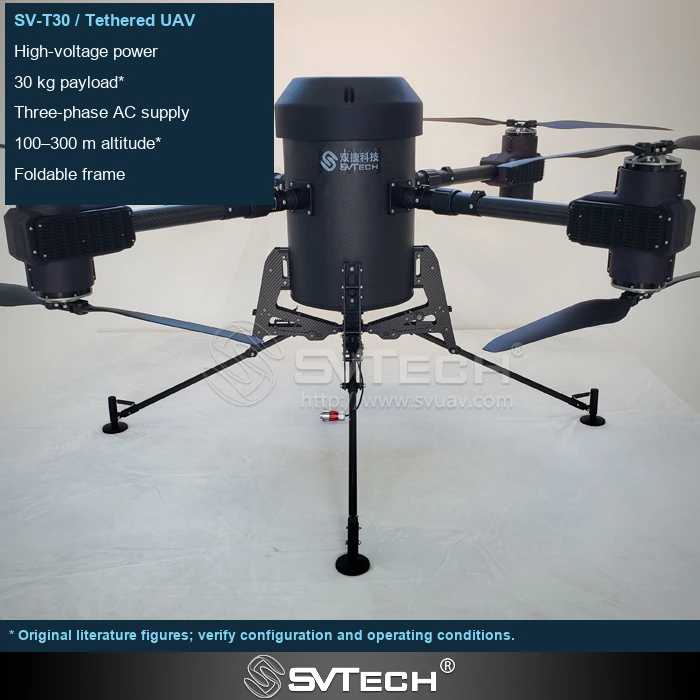
Resource supply and flight stability interact
The cable carries electrical power and performs certain mechanical functions, while the hose also involves the mass of the water inside it, flow, and jet effects. The two differ in bending, elongation, and towing characteristics; they cannot be combined into a single static weight with the motion process ignored.
The medium inside the hose adds weight, and changes in flow rate and jetting can also produce dynamic effects; the cable, for its part, has its own transmission and pay-out/retrieval requirements. The relative position, routing, and deployment of the two paths affect platform motion. System design should coordinate water supply, power supply, and flight control, rather than completing each separately and combining them ad hoc afterward.
When water supply starts, the hose state may change; during lateral movement, the two paths may also become entangled. A flight demonstration carried out only in a dry state cannot represent real cleaning conditions.
Technical principles and engineering boundaries
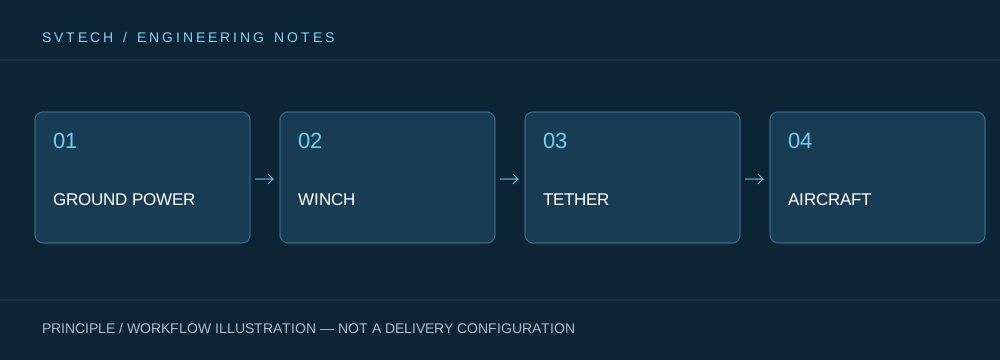
A tethered drone connects the ground power supply, the pay-out/retrieval mechanism, the tether, the flight platform, and the mission payload into one continuous system. When designing around "Power and Water Aloft Together: Dual-Link Design for a Tethered Cleaning Platform," power supply efficiency, tether weight, tension variation, payload heat dissipation, and flight control all interact. The system cannot be described only by its maximum endurance; whether it can maintain stable service at a specified altitude, in given wind conditions, with a given payload power, and under personnel rotation is the more meaningful capability of a continuously powered drone.
Application scenarios and implementation path
Persistent observation, temporary communications relay, nighttime emergency lighting, and security for specific areas are all missions a tethered platform may serve. They all require an aerial position that remains available over time, while each also imposes different requirements on imagery, link, lighting, or deployment speed. Incorporating mission objectives, ground power, operating area, weather window, and exit path into the plan together allows a tethered drone system to move from a demonstration device to an on-site, organizable service.
Project validation and continuous optimization
To ground this technical discussion of "Power and Water Aloft Together: Dual-Link Design for a Tethered Cleaning Platform" in real projects, the validation phase should record the configuration version, environmental conditions, measurement locations, and mission results together. Define the respective fixation points, guides, and permissible loads; check the mass and dynamic behavior after the hose is filled with water; and verify ascent, hovering, and retrieval as a complete configuration. This information is not supplementary documentation but the shared basis for interpreting results, reproducing performance, and continuously optimizing.
Related support from SV Tech
Zhuhai SV Tech Co. Ltd. provides product documentation, project requirement discussions, and configuration boundary checks for tethered drones and related industry applications. For topics such as "Power and Water Aloft Together: Dual-Link Design for a Tethered Cleaning Platform," you can describe the mission conditions, target outcomes, site environment, and existing equipment together, and Mr. Liu (+86 18688194199, lhc1983@gmail.com) will assist with the coordination; specific models, performance, and delivery scope are subject to confirmed documentation and project validation.
The weight, pressure changes, and jet reaction of a water-filled hose differ from the load mechanism of the cable. The layout drawing of a cleaning system should identify the hose and cable paths separately, then confirm the loads at their shared fixation points. Flight load must not be estimated from the dry hose weight, nor should water supply stability be inferred solely from cable tension control logic.
Multi-resource tethering expands the possibilities for sustained operation. Only by understanding the physical characteristics of the different links can long-duration supply be turned into stable, controllable cleaning capability.
