
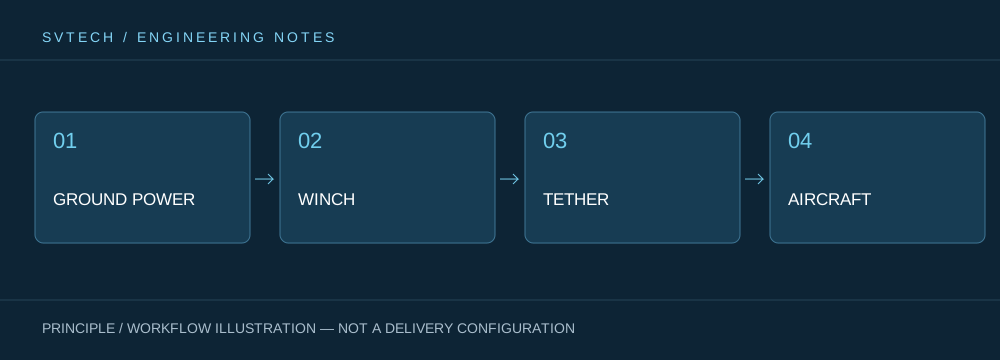
Tethered drones allow ground power to serve aerial payloads, supported by an energy chain that passes through power distribution, conversion, cable transmission and onboard regulation. Each segment affects the next, so the location of the outlet and the power supply conditions are also part of the system design.
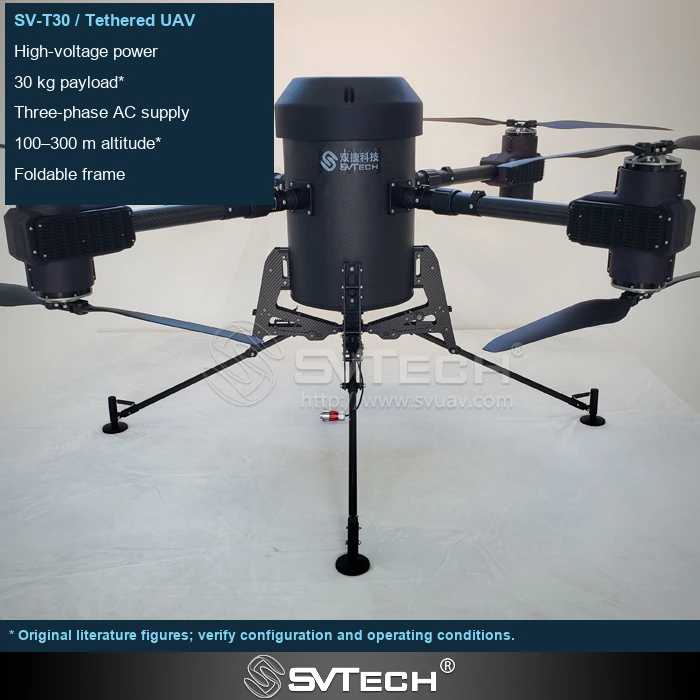
Ground energy must adapt to dynamic missions
Supply voltage, number of phases, frequency, available capacity and protection configuration all need to be checked. The presence of a site outlet does not prove that the upstream distribution allows it to continuously carry the target load; other equipment running at the same time may also cause voltage drops or tripping.
Power demand changes when the drone takes off, adjusts attitude and starts its payload. Other equipment on site sharing the circuit may also cause fluctuations. Stable energy not only means sufficient average power, but also involves protection configuration, connection reliability and power quality. Understanding these conditions in advance can reduce the time spent repeatedly adjusting equipment after arriving on site.
Cleaning projects often share power with water pumps, and startup peaks and long extension cables further change conditions. The entire distribution path should be checked, rather than measuring the outlet voltage only once under no load.
Technical Principles and Engineering Boundaries
A tethered drone connects ground power, the tether management mechanism, the cable, the flight platform and the mission payload into one continuous system. When designing around "From a Power Source to an Aerial Workstation: The Energy Chain of a Tethered System," power efficiency, cable weight, tension variation, payload heat dissipation and flight control all affect one another. The system cannot be described only by maximum endurance time; whether it can maintain stable service under specified altitude, wind conditions, payload power and personnel rotation conditions is what makes a continuously powered drone's capability more practically meaningful.
Application Scenarios and Implementation Paths
Persistent observation, temporary communication relay, nighttime emergency lighting and security for specific areas are all missions a tethered platform may serve. Together they require the aerial position to be available over the long term, and they each place different demands on imagery, link, illumination or deployment speed. Incorporating mission objectives, ground power, operating area, weather window and exit path into the plan can turn a tethered drone system from a demo device into an on-site service that can be organized.
Project Validation and Continuous Optimization
To make this technical discussion about "From a Power Source to an Aerial Workstation: The Energy Chain of a Tethered System" applicable to real projects, the verification stage should record the configuration version, environmental conditions, measurement locations and mission results together. Obtain the power supply conditions and system input requirements in advance, and have them verified by qualified electrical personnel; plan grounding, isolation and emergency power cutoff. Include site power supply verification in the site acceptance process. This information is not supplementary documentation, but the shared basis for interpreting results, reproducing performance and continuously optimizing.
Related Support from SVTECH
SVTECH provides product information, project requirement communication and configuration boundary verification for tethered drones and related industry applications. For topics such as "From a Power Source to an Aerial Workstation: The Energy Chain of a Tethered System," mission conditions, target outcomes, on-site environment and existing equipment can be described together, and Mr. Liu (+86 18688194199, lhc1983@gmail.com) can assist with coordination; specific models, performance and delivery scope are subject to confirmed documents and project verification.
Survey materials need to include the power supply type, available capacity, grounding and protection configuration, and the distance from the connection point to the ground station. Water pumps or other loads running at the site at the same time should also be recorded. The installation plan should be verified by the appropriate professionals; a single photo of an outlet usually cannot prove that the power supply conditions meet the equipment requirements.
Stable aerial service often begins with the basic ground conditions. By incorporating power supply planning into the plan in advance, a tethered system can more easily achieve rapid deployment and continuous operation.
