
Battery-powered drones excel at rapid arrival, while tethered drones offer a different approach: continuous power via a cable, allowing the platform to perform observation, illumination or communication tasks in a fixed area. The focus of application shifts from how far it can fly to what services an aerial position can continuously provide.
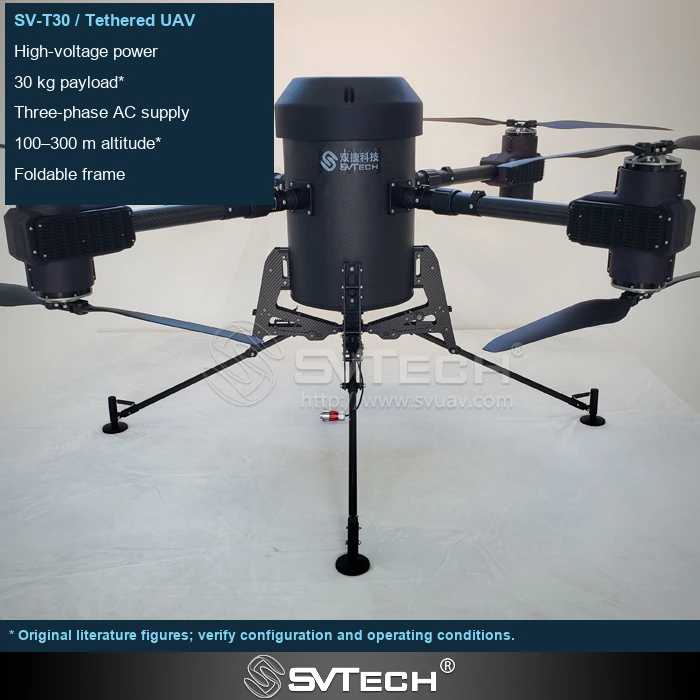
Continuous power supply changes how missions are organized
Ground power supply reduces battery swap constraints, but motors, ESCs, payloads, communications and personnel still have continuous operation boundaries. Continuous power supply does not mean maintenance or weather changes can be ignored, nor does it mean unlimited station-keeping under any payload.
When energy moves from onboard batteries to the ground, aerial weight distribution and battery swap procedures change accordingly. However, motors, power modules and payloads still generate heat, and the ground station also requires maintenance. Long-endurance capability is the result of power supply, heat dissipation, personnel and environment working together. When evaluating a project, continuous missions, short downtime and recovery procedures need to be understood on the same timeline.
Mission planning should separate the machine's continuous operating capability from crew rotation, ground power replenishment and cable inspection. During long-duration observation, payload temperature rise may become the constraint before the propulsion system does.
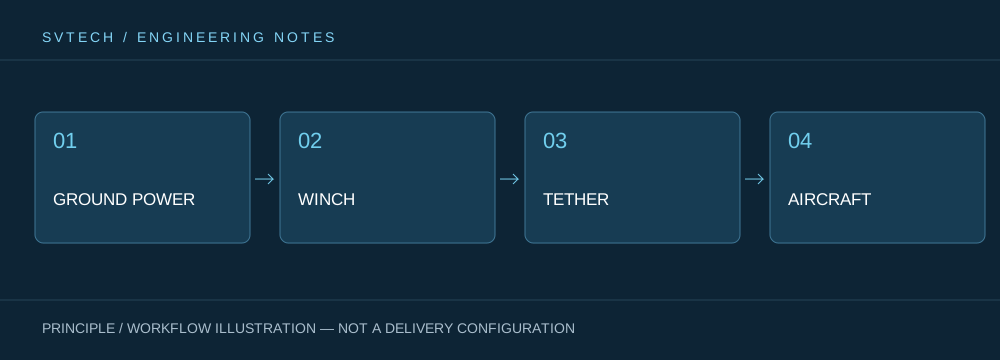
Technical Principles and Engineering Boundaries
A tethered drone connects ground power, the tether management mechanism, the cable, the flight platform and the mission payload into one continuous system. When designing around "Tethered Drones: Turning Aerial Platforms into Continuously Operating Infrastructure," power supply efficiency, cable weight, tension variation, payload heat dissipation and flight control all influence one another. The system cannot be described solely by maximum station-keeping time; whether it can maintain stable service under specified altitude, wind conditions, payload power and personnel rotation is the more practically meaningful capability of a continuously powered drone.
Application Scenarios and Implementation Paths
Persistent observation, temporary communication relay, nighttime emergency lighting and security for specific areas are all missions a tethered platform may serve. Together they require the aerial position to be available over the long term, and they each place different demands on imagery, link, illumination or deployment speed. Incorporating mission objectives, ground power, operating area, weather window and exit path into the plan can turn a tethered drone system from a demo device into an on-site service that can be organized.
Project Validation and Continuous Optimization
To ground this technical discussion on "Tethered Drones: Turning Aerial Platforms into Continuously Operating Infrastructure" in real projects, the verification phase should record configuration versions, environmental conditions, measurement locations and mission results together. Confirm continuous operation data for the complete configuration; agree on monitoring items and exit conditions; record maintenance and shift changes. Verify continuous capability under actual mission conditions rather than citing only the longest demonstration time. This information is not supplementary documentation, but the shared basis for interpreting results, reproducing performance and continuous optimization.
Related Support from SVTECH
SVTECH provides product documentation, project requirement communication and configuration boundary verification for tethered drones and related industry applications. For topics such as "Tethered Drones: Turning Aerial Platforms into Continuously Operating Infrastructure," you can describe mission conditions, target outcomes, site environment and existing equipment together, and Mr. Liu (+86 18688194199, lhc1983@gmail.com) will assist with coordination; specific models, performance and delivery scope are subject to confirmed documentation and project verification.
Mission planning should also include arrangements for personnel rotation, weather re-checks, payload maintenance and ground energy replenishment. Continuous power supply solves the energy source problem; it cannot eliminate all interruption factors. Acceptance can use complete mission records within an agreed time period, listing pauses and reasons, without extrapolating a short demonstration into an unlimited-duration operation commitment.
Tethered technology extends dwell capability. Only by integrating aerial equipment with ground support into a complete system can longer mission time be converted into stable service.
