
A tethered cable must carry power and also withstand repeated bending and stowing. The conductor, insulation and jacket each experience strain at different locations. Cable life is therefore not determined by operating hours alone; it also depends on the path taken during every deployment and retrieval.
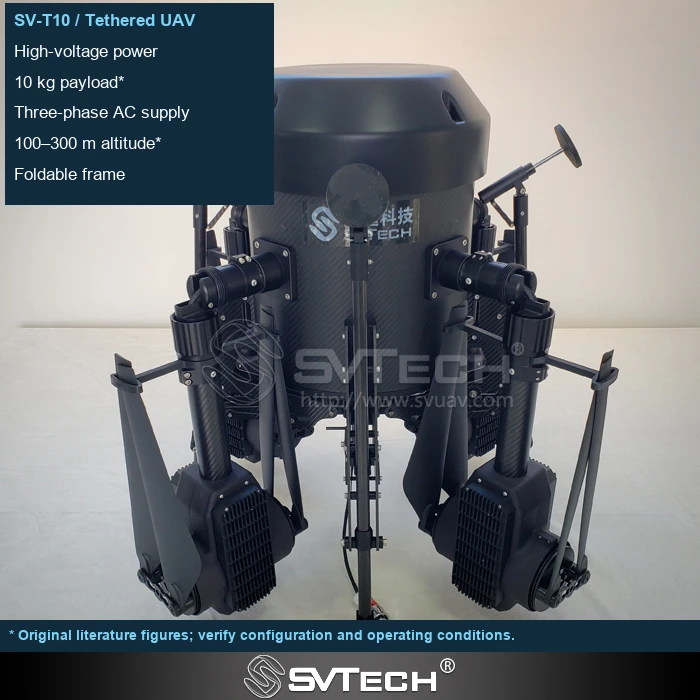
Distributing bending more smoothly
Repeated small-radius bending imposes stress on the conductor, insulation and load-bearing structure, and creases may appear before any external damage. The permissible bend radius generally depends on the cable construction and the way it is used dynamically, and it should not be judged by feel.
Guide pulley diameter, exit angle and localized pinching all change how concentrated the forces are. Too small a bend radius can cause certain locations to repeatedly endure greater strain, even when no change is immediately visible on the outside. Sensible routing reduces sharp turns and friction and makes inspection points easier to reach. When replacing a cable, its dynamic service conditions should also be confirmed.
Adding a small guide pulley on site to route around a sharp fence corner can alter the original fatigue conditions. Even if operation is normal that day, damage may accumulate after repeated missions.
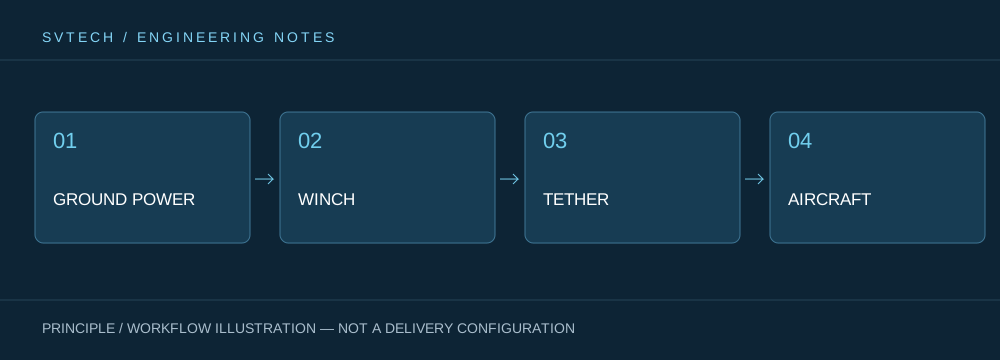
Technical principles and engineering boundaries
A tethered drone connects the ground power supply, the deploy-and-retrieve mechanism, the cable, the flight platform and the mission payload into one continuous system. When designing around "The Fatigue Journey of a Flexible Cable: Every Bend Shapes Its Service Life," power efficiency, cable weight, tension variation, payload cooling and flight control all affect one another. The system cannot be described by maximum endurance alone; whether it can maintain stable service under a specified altitude, wind conditions, payload power and crew rotation is what makes a persistently powered drone genuinely useful.
Application scenarios and implementation paths
Persistent observation, temporary communications relay, nighttime emergency lighting and security in specific areas are all missions a tethered platform can serve. They share a common requirement for long-term availability of the aerial position, while each places different demands on imagery, link, illumination or deployment speed. Bringing mission objectives, ground power, operating area, weather window and exit path into the plan together can turn a tethered drone system from a demonstration device into an on-site service that can be organized.
Project validation and continuous optimization
To ground this technical discussion of "The Fatigue Journey of a Flexible Cable: Every Bend Shapes Its Service Life" in real projects, the validation phase should record configuration version, environmental conditions, measurement locations and mission results together. Check dynamic and static bending requirements, and inspect guide pulley dimensions and contact edges; record any abnormal pinching or bending events. If visible creases appear, evaluate them according to the manufacturer's procedure rather than straightening the cable and continuing to use it. This information is not supplementary documentation but the shared basis for interpreting results, reproducing performance and continuously optimizing.
Related support from SV Tech
SV Tech (SVTECH) provides product documentation, project requirement discussions and configuration boundary checks for tethered drones and related industry applications. For topics such as "The Fatigue Journey of a Flexible Cable: Every Bend Shapes Its Service Life," you can describe the mission conditions, target outcomes, site environment and existing equipment together, and Mr. Liu (+86 18688194199, lhc1983@gmail.com) will assist with coordination; specific models, performance and delivery scope are subject to confirmed documentation and project validation.
The minimum bend radius should come from the documentation for the specific cable, and a distinction must be made between static routing and repeated motion. Guide pulleys, exit ports and stowing corners all need to be checked, not just the drum. After switching to a cable from a different supplier, even with the same outer diameter, the existing bending conditions and service-life assumptions should not be carried over directly.
Durability often comes from path design. Attending to every bend can reduce hidden fatigue over long-term use and make the tethered connection more reliable.
