
Continuous ground power does not mean the onboard battery loses its value. When the primary power supply behaves abnormally, the backup energy source must support the system through the defined actions. Its design goal differs from ordinary endurance: it prioritizes available power and energy margin during critical phases.
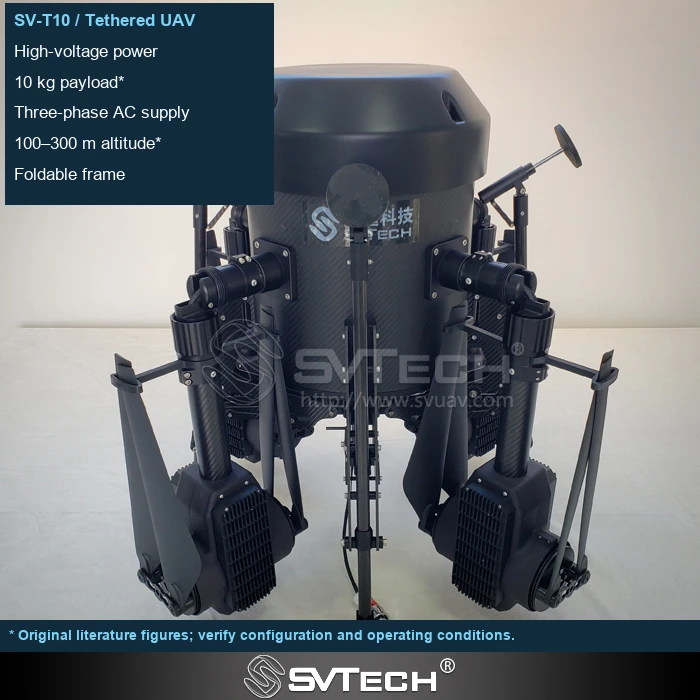
The exit process is a changing power curve
The purpose and capacity requirement of the backup energy source should be defined by the fault-handling procedure. Holding hover, controlled descent and recovery with payload have different power curves, and battery temperature, ageing and available state of charge must also be considered.
Descent, position holding and final touchdown may require different loads, and are further affected by current altitude, wind and battery condition. Backup time should therefore be tied to the specific exit strategy and cannot be extrapolated from ideal hover data alone. The health of a battery after long standby is also critical; a capacity readout is no substitute for actual available capability.
If the backup mode requires stabilizing attitude before descent, the energy budget cannot simply assume an ideal descent time. Whether the payload is disconnected during the switchover also affects the available time, and the actual control logic must be checked.
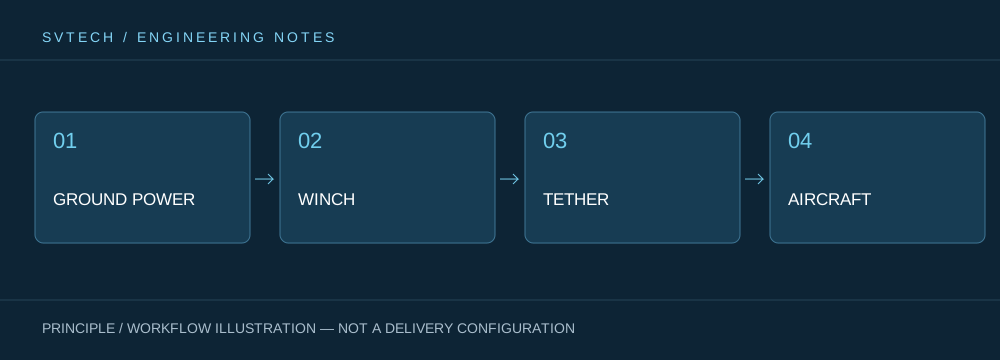
Technical principles and engineering boundaries
A tethered drone connects ground power, the tether winch mechanism, the cable, the flight platform and the mission payload into one continuous system. When designing around “Backup Battery for Tethered Platforms: Reserving Energy for a Safe Exit”, power supply efficiency, cable weight, tension variation, payload cooling and flight control all interact. A system cannot be described by maximum airborne time alone; whether it can maintain stable service at a specified altitude, wind condition, payload power and personnel rotation is the more meaningful capability of a continuously powered drone.
Application scenarios and implementation paths
Persistent observation, temporary communication relay, night emergency lighting and security for specific areas are all missions a tethered platform may serve. They share a requirement for long-term availability of the aerial position, while each places different demands on imagery, link, illumination or deployment speed. Incorporating mission objectives, ground power, operating area, weather window and exit path into the plan together allows a tethered drone system to move from a demonstration device to an organizable on-site service.
Project verification and continuous optimization
To ground this technical discussion of “Backup Battery for Tethered Platforms: Reserving Energy for a Safe Exit” in real projects, the verification phase should record configuration version, environmental conditions, measurement locations and mission results together. Request documentation of the backup mode and applicable load conditions; verify the switchover, alarm and recovery procedures; establish a battery inspection and replacement plan. Do not derive safe airborne minutes directly from nominal battery capacity. This information is not supplementary documentation but the shared basis for interpreting results, reproducing performance and continuously optimizing.
Related support from SV Tech
Zhuhai SV Tech Co. Ltd. provides product documentation, project requirement discussion and configuration boundary checks for tethered drones and related industry applications. For topics such as “Backup Battery for Tethered Platforms: Reserving Energy for a Safe Exit”, mission conditions, target outcomes, site environment and existing equipment can be described together, with Mr. Liu (+86 18688194199, lhc1983@gmail.com) assisting with coordination; specific models, performance and delivery scope are subject to confirmed documentation and project verification.
The backup energy requirement should correspond to defined safety actions, including fault identification, switchover, descent and necessary operating margin. Different payloads and battery states change the available time. The acceptance plan can verify the entire process under controlled conditions, with stop criteria stated, rather than calculating emergency handling capability directly from the nominal capacity of an unloaded battery.
The value of backup energy is to give the system a clear next step. Designing the battery, alarms and exit actions together makes abnormal handling more predictable.
