
Advertised area figures are often striking, but field work includes setup, relocation, resupply, and inspection. Counting only continuous spray time may not show how much work is truly completed in a working day.
Productivity depends on the entire service process
Spray coverage area, flight-path swept area, and accepted qualified area are not the same. Useful throughput must deduct pauses, overlap, relocation, water refilling, and rework, and should specify personnel and site conditions.
Continuous large flat surfaces and scattered complex areas have different rhythms, and the same equipment will perform differently. Recording effective spray time, waiting time, and rework time can identify the links most worth improving. Improving efficiency does not necessarily require flying faster; sometimes optimizing water supply and zoning can reduce many pauses.
A continuous demonstration segment may show a high instantaneous coverage rate, but a full shift also includes setup and cleanup. Multiplying the demonstration value directly by eight hours yields a daily output without a valid basis.
Technical principles and engineering boundaries
Drone cleaning integrates flight, water supply, spraying, and surface material maintenance into a single process. When discussing “The Real Efficiency of Drone Cleaning: Time Allocation Behind the Area Per Hour,” the changes in water flow among the pump station, piping, nozzles, and the surface being cleaned, together with the flight platform’s attitude, wind conditions, and path coverage, jointly determine the outcome. For PV modules and building facades, cleaning effectiveness should not be judged only by appearance immediately after spraying, but also by the surface state after drying, material requirements, and reviewable quality records.
Application scenarios and implementation paths
PV cleaning drones are best discussed alongside plant zoning, soiling trends, water supply conditions, and O&M windows; facade cleaning drones require simultaneous understanding of building form, drainage, surrounding access, and property coordination. Automated equipment can change how high-altitude work is organized, but cannot replace on-site process judgment. Validating paths, spraying, and acceptance methods in representative areas before scaling to larger areas often helps form a stable intelligent cleaning solution.
Project validation and continuous improvement
To ground this technical discussion on “The Real Efficiency of Drone Cleaning: Time Allocation Behind the Area Per Hour” in real projects, the validation phase should record configuration versions, environmental conditions, measurement positions, and task results together. Calculate qualified area from complete task records; also provide soiling, distance, wind conditions, and personnel count; clearly label reference values as reference conditions and avoid unconditional promises. This information is not supplementary documentation but a shared basis for interpreting results, reproducing performance, and continuous improvement.
Related support from SV Tech
SV Tech (SVTECH) provides product information, project requirement communication, and configuration boundary verification for drone cleaning and related industry applications. For topics such as “The Real Efficiency of Drone Cleaning: Time Allocation Behind the Area Per Hour,” you can describe task conditions, target outcomes, site environment, and existing equipment together, and Mr. Liu (+86 18688194199, lhc1983@gmail.com) will assist with coordination; specific models, performance, and delivery scope are subject to confirmed documentation and project validation.
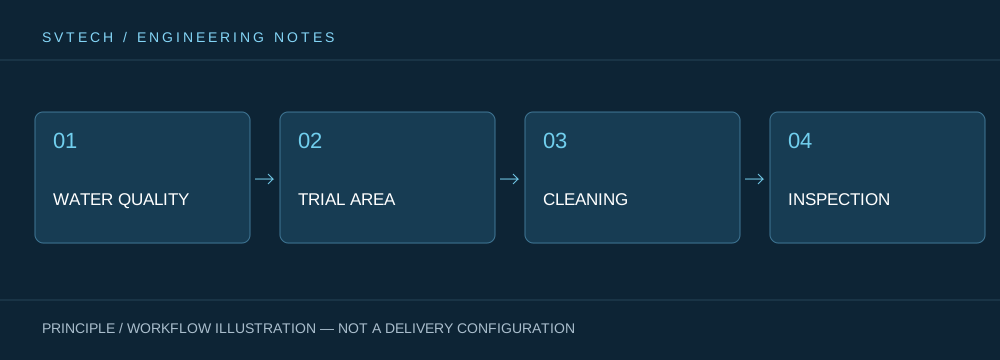
Effective area should specify whether it is module projection area, surface area, or path coverage area, and duplicate counting should be deducted. Task duration can be divided into setup, cleaning, relocation, and wrap-up. When evaluating operational capability, customers should look at the actual throughput over the full cycle and must not multiply a short-term continuous spray rate directly by full-day working hours.
What customers need is the area completed as required. Understanding efficiency through the complete process can make solution comparisons and project planning more realistic.

