
Special-purpose robots extend people out of high-risk, hard-to-reach or repetitive work positions. Seeing Straight Ahead Is Not Enough: Spatial Blind Spots in Robot Perception returns this question to the task site, where the links between equipment, environment and personnel often become visible.
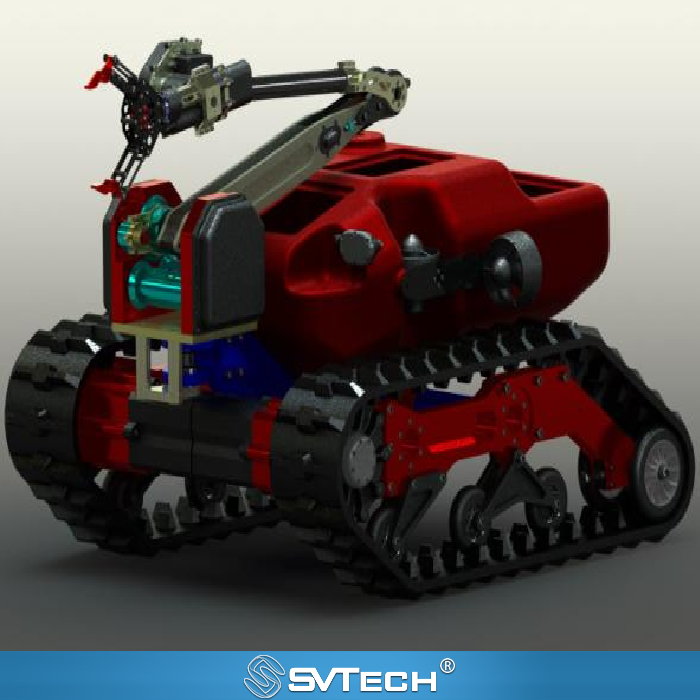
Seeing Straight Ahead Is Not Enough: Spatial Blind Spots in Robot Perception
Field of view and mounting position determine the visible range; a forward image cannot cover the chassis edges, the rear or high-mounted payloads. Operators also need to understand lens distortion and depth perception.
Truly usable robot capability comes from the coordination of mechanics, perception, control and on-site personnel. From this starting point, technical choices come closer to the results users actually care about. Verify observability through representative narrow passages; define observer and recovery strategies; train personnel to use the correct references. Acceptance should cover complete maneuvers, not just static resolution.
During turns and reversing, local blind spots can become the main risk. Adding cameras does not solve the problem automatically; view switching and operator habits must also be designed.
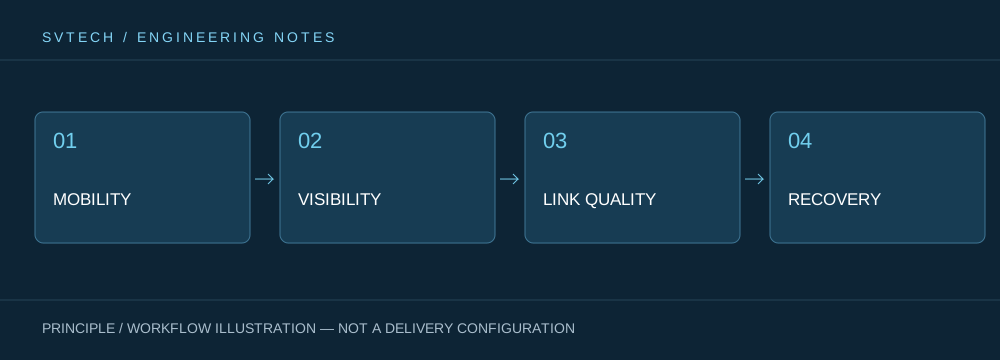
Technical principles and engineering boundaries
Special-purpose robots bring the mobile chassis, actuators, sensors, communications and human-machine interface into one on-site system. "Seeing Straight Ahead Is Not Enough: Spatial Blind Spots in Robot Perception" reminds us that product specifications must be understood together with ground conditions, payload state, operator position and task duration. Speed, gradeability, endurance or ingress protection are not absolute conclusions detached from the environment; a robot's capability boundary has engineering meaning only under specified routes, obstacles, temperatures and control methods.
Application scenarios and implementation paths
Firefighting, hazardous-environment inspection, industrial inspection and emergency rescue are the most valuable application areas for special-purpose robots. Their common goal is to extend personnel perception and operating range, and to reduce direct-approach risk under suitable conditions. Before deployment, the task area, communication conditions, entry and recovery paths, personnel responsibilities and information handover should be designed together, so that robot intelligence truly serves on-site decisions rather than merely demonstrating individual actions.
Project validation and continuous improvement
To ground this technical discussion of "Seeing Straight Ahead Is Not Enough: Spatial Blind Spots in Robot Perception" in real projects, the validation phase should record the configuration version, environmental conditions, measurement positions and task results together. Verify observability through representative narrow passages; define observer and recovery strategies; train personnel to use the correct references. Acceptance should cover complete maneuvers, not just static resolution. This information is not supplementary documentation but a shared basis for interpreting results, reproducing performance and continuously improving.
Related support from Zhuhai SV Tech Co. Ltd.
Zhuhai SV Tech Co. Ltd. provides product documentation, project requirement discussion and configuration boundary checks for special-purpose robots and related industry applications. For topics such as "Seeing Straight Ahead Is Not Enough: Spatial Blind Spots in Robot Perception", the task conditions, target outcomes, site environment and existing equipment can be described together, with Mr. Liu (+86 18688194199, lhc1983@gmail.com) assisting with coordination; specific models, performance and delivery scope are subject to confirmed documentation and project validation.
Representative side and low-level targets can be placed in a controlled passage to observe whether the operator detects them in time. Missed locations should be reflected in payload layout, on-screen cues or observer arrangements. Testing should not be repeated only at positions where the operator has already memorized every obstacle, as this would overestimate observability.
Only by continuously accumulating this experience can teams make similar tasks increasingly reliable.
