

Understand what the meter measures
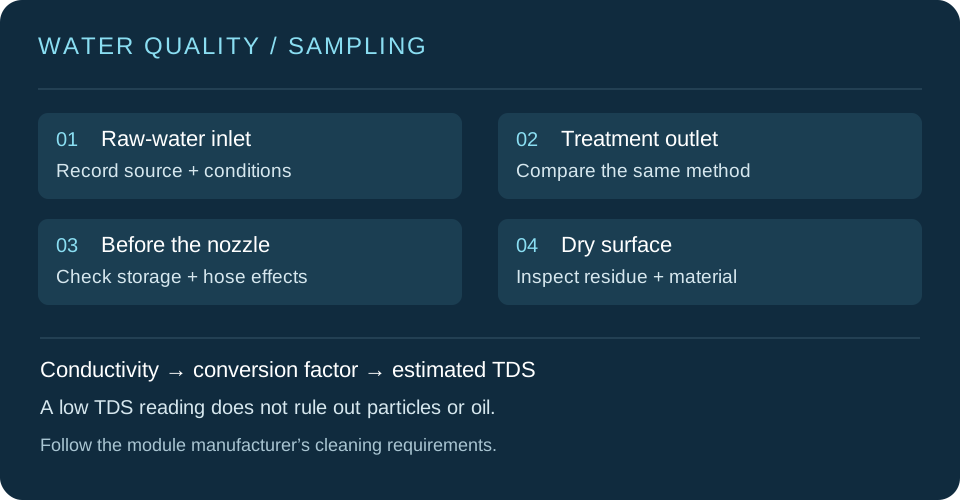
Many handheld TDS meters measure electrical conductivity and use a built-in factor to estimate total dissolved solids. Conductivity primarily reflects the ability of dissolved ions to carry current. The conversion depends on ion composition, temperature handling and instrument settings, so ppm readings from different meters are not necessarily comparable. Record the meter model, calibration date, original conductivity reading, temperature and conversion setting. Tracking one water source consistently is more useful than treating a single reading as a universal pass certificate. A laboratory result obtained by a specified method should also be distinguished from a handheld estimate.
Recognise what a low reading can miss
Conductivity or estimated TDS alone cannot rule out suspended particles, some organic contaminants, oil films or microbiological problems. Grit can scratch a surface during contact or movement; oily contamination can leave a film; cleaning-agent residue can affect the appearance after drying. Each calls for a different investigation. If a cleaned module still shows defects, a low meter reading does not eliminate water quality as a cause, and dissolved salts are not the only possible explanation. Narrow the investigation using the shape, location and process history of the defect.
Sample along the supply path
Identifiable sampling points at the raw-water inlet, treatment outlet and upstream of the nozzle help locate a problem. Record flow conditions and how long the equipment has been operating. If inlet water is satisfactory but the endpoint is not, investigate storage, hoses, filter maintenance and residues in the line. If the treatment outlet is already abnormal, examine treatment performance and source-water changes first. Use containers suitable for the intended analysis and avoid contamination from previous samples. Compare points using the same method under similar conditions rather than relying on one measurement in the tank.
Record line flushing separately from normal-operation sampling after commissioning or a period out of use. Stagnant water does not necessarily represent the flowing supply, and deposits may be released during start-up. After servicing treatment equipment, do not check only whether the meter reading recovers; repeat the specified endpoint checks. This connects results to equipment condition instead of allowing an old source-water report to replace site inspection indefinitely.
Use module requirements to define acceptance
PV glass, coatings, frames, seals and connections may have different cleaning restrictions. Water quality, chemicals, temperature and cleaning methods should follow the module manufacturer's instructions and applicable project maintenance requirements. No universal TDS threshold replaces the requirements for every module. Where documentation is incomplete, obtain written conditions before defining a trial. Acceptance should cover soil removal, spotting and residue after drying, surface condition and any changes around joints.
Turn water marks into testable hypotheses
For white spots, first observe whether deposits collect at the edges of dried droplets, then compare water samples and filter-maintenance records. For streaks, also examine spray coverage, drainage direction and areas that may not have been fully rinsed. Compare the existing and adjusted processes on adjacent representative areas of the same material, changing one major variable at a time, such as treatment or rinsing method. Stronger chemicals should not be used to conceal an unexplained defect. Photograph the dry surface and record the time and lighting, so changes in reflection are not mistaken for changes in cleaning quality.
Make water quality part of routine maintenance
A useful record includes the water source, sampling point, meter and calibration status, reading, temperature, treatment or filter maintenance, trial area and acceptance result. When readings change abruptly, check the instrument and sampling method before tracing the supply path. Water quality, nozzles, hoses and cleaning procedure need to be considered together. Zhuhai SV Tech Co. Ltd. can discuss supply and operating configurations using current documentation for the SV-M30 PV cleaning drone. Module maintenance instructions and site water-quality records help define the validation required. A low reading is a useful clue; complete water-quality and material assessments establish the operating conditions.
Business enquiries: Mr Liu, +86 18688194199, lhc1983@gmail.com.
