
The instant a camera captures an image must correspond precisely to the position recorded by the positioning system. When a UAV is in continuous motion, even a tiny timing offset can become a spatial offset. Multi-sensor platforms are especially dependent on this correspondence, because imagery, inertial navigation and other data must be interpreted on the same timeline.

Synchronization connects different sensors into one system
Position must correspond to the exposure instant, and timing offsets convert into position errors during motion. A high recording rate does not mean synchronization is accurate; the latency and triggering method in the system must be verified.
Timestamp sources, triggering methods and transmission latency all affect whether data is truly synchronized. Seeing similar timestamps in a file does not necessarily mean exposure and positioning are aligned. Engineering design should clearly describe the timing of each device and verify it under actual speed and acquisition modes, rather than leaving timing issues to guesswork in post-processing.
The same timing offset has different effects at different speeds, so static tests cannot fully validate dynamic acquisition. If data shows a systematic offset, the synchronization chain should be checked rather than only adjusting coordinates.
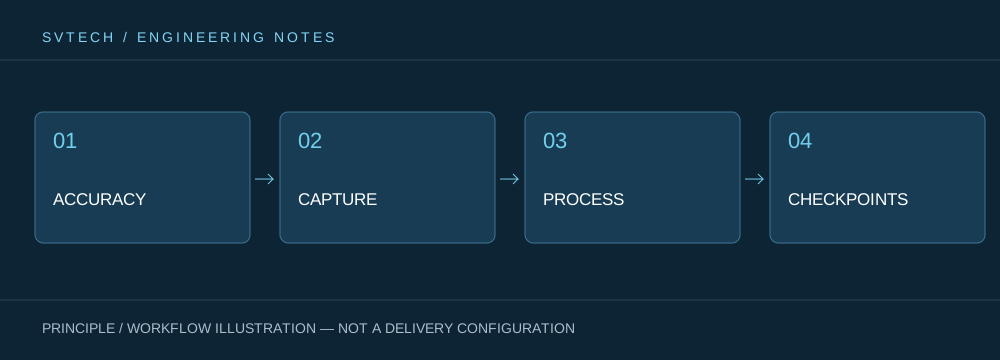
Technical principles and engineering boundaries
The capability of an industrial UAV is jointly determined by the flight platform, propulsion, perception payload, communication and data workflow. The phenomena covered in “Spatial Error Within Milliseconds: Time Synchronization for UAV Sensors” often occur at the interfaces between these elements: a platform flying stably does not mean the data is deliverable; an algorithm capable of recognizing a target does not mean the mission can proceed without human supervision. Only by placing performance back into the full mission chain can one distinguish between a demonstration, repeatable verification and long-term operation.
Application scenarios and implementation paths
UAV inspection, 3D modeling, emergency response and asset management are all driving the low-altitude economy into industrial sites. Different applications require different flight paths, data quality, on-site coordination and compliance preparation. If the target object, deliverable format, operating frequency, site constraints and exception handling can be clearly defined early in a project, industrial UAV applications are more likely to select suitable platforms and payloads and establish a sustainable data acquisition process.
Project verification and continuous improvement
To ground this technical discussion of “Spatial Error Within Milliseconds: Time Synchronization for UAV Sensors” in real projects, the verification phase should record configuration versions, environmental conditions, measurement positions and mission results together. Clarify triggering and time sources, document configuration and latency handling; verify with controlled tests; retain raw logs. Result quality must be ensured jointly by hardware and software interfaces. This information is not supplementary documentation but the shared basis for interpreting results, reproducing performance and continuously improving.
Related support from SV Tech
Zhuhai SV Tech Co. Ltd. provides product documentation, project requirement discussions and verification of configuration boundaries for industrial UAVs and related industry applications. For topics such as “Spatial Error Within Milliseconds: Time Synchronization for UAV Sensors,” mission conditions, target deliverables, site environment and existing equipment can be described together, and Mr. Liu (+86 18688194199, lhc1983@gmail.com) will assist with coordination; specific models, performance and delivery scope are subject to confirmed documentation and project verification.
Interface documentation should specify triggering, timestamp sources and latency handling, and verification should use the entire acquisition chain. Timing errors and motion act together, so normal static ground tests are not sufficient. Synchronization settings and versions should be retained in delivered data to facilitate later interpretation of result differences and reproduction of processing.
High-quality data comes from reliable correspondence. Treating time synchronization as part of integration work allows sensor performance to be more fully translated into final result quality.
