
Large propeller blades offer efficiency potential, but also bring greater startup inertia. For a motor to transition from standstill into stable rotation, it must build sufficient torque while the controller reliably determines rotor position. If the startup phase is repeatedly jittery, the cause may lie in a combination of inertia, connections, control strategy or mechanical resistance—not simply “the motor isn't strong enough.”
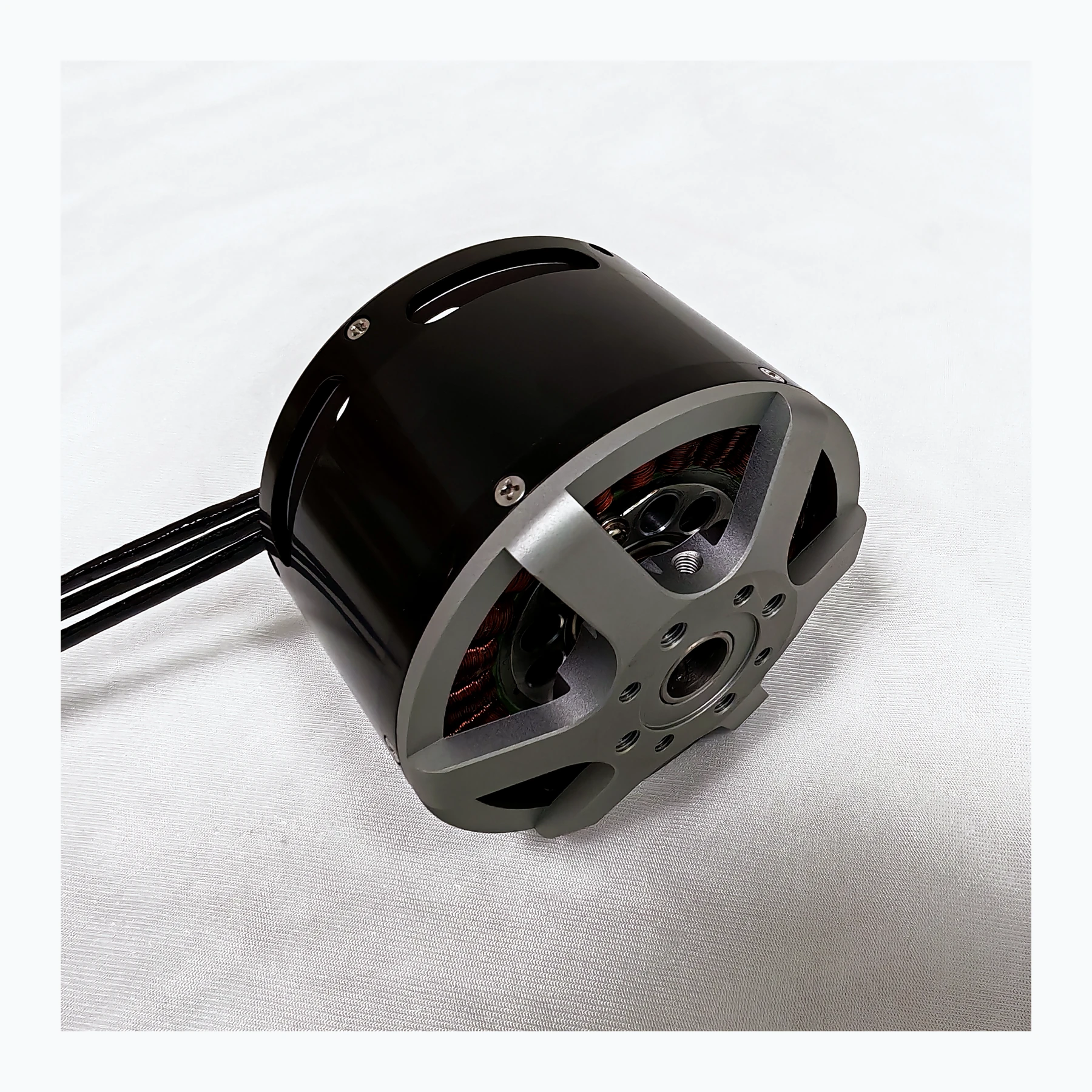
Startup Is a Distinct Operating Scenario
Greater rotational inertia requires a longer acceleration process, and the startup phase may lack stable back-EMF information. If the startup ramp, initial current and position detection are not properly matched, the rotor may oscillate back and forth. Repeated startup attempts accumulate heat, so “try a few more times” is not a viable solution.
Sensorless drive has limited information available at standstill and low speed, and heavy propellers extend the process of reaching stable operation. An overly aggressive acceleration may increase current stress, while an overly conservative one may fail to cross certain load ranges. A suitable startup scheme should be validated under actual propeller and power supply conditions, with each motor's consistency observed. For industrial platforms, a smooth and repeatable startup also reduces structural shock and makes ground inspections more likely to reveal anomalies.
Dividing the problem into no-load and loaded cases helps with diagnosis: if anomalies occur even without a propeller, check wiring, controller and mechanical binding first; if anomalies occur only after mounting the propeller, further investigate propeller inertia, supply voltage drop and the manufacturer's recommended startup strategy. Isolation and protection must be completed before each inspection.
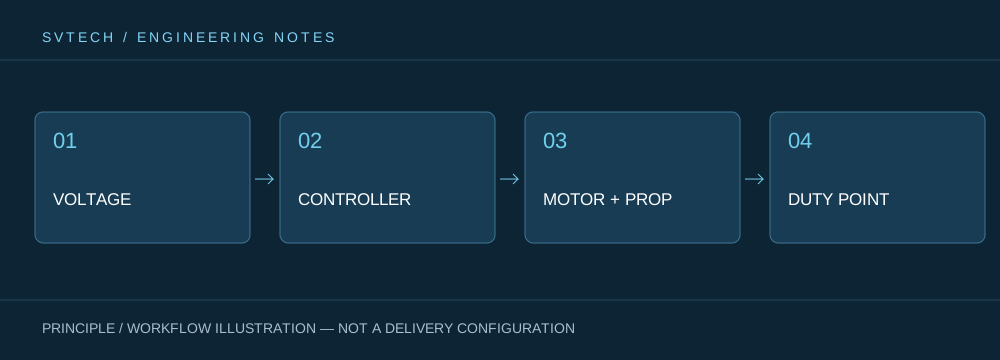
Technical Principles and Engineering Boundaries
A UAV motor is not an isolated actuator. Battery, ESC, windings, propeller and frame together determine how electrical energy is converted into lift and attitude control force. When discussing “Smooth Startup for Heavy-Lift UAVs: Understanding Dynamic Response Through Propeller Inertia,” the continuous operating point, short-term peak, thermal path and mounting loads should be viewed on the same mission curve: no-load speed, maximum current or single-point thrust each describe only one facet. For industrial UAV propulsion systems, reliably completing inspection, transport or hover missions is usually more important than a peak figure from a single bench test.
Application Scenarios and Implementation Paths
In applications such as surveying, inspection, logistics and tethered platforms, power requirements change with payload, flight phase and ambient temperature. Engineering teams can first define the target thrust, the common cruise or hover range and the allowable temperature rise, then review whether supply voltage, KV, propeller and control strategy match. This UAV propulsion selection process also preserves clear technical boundaries for subsequent spare parts, maintenance and upgrades.
Project Validation and Continuous Optimization
To ground this technical discussion of “Smooth Startup for Heavy-Lift UAVs: Understanding Dynamic Response Through Propeller Inertia” in real projects, the validation phase should record configuration version, environmental conditions, measurement locations and mission results together. Save startup voltage and error codes, check phase wire connection quality, and validate startup configuration according to the supplier's procedure. Any test with propellers mounted must be conducted on a suitable bench and in an isolated area; never judge faults by holding the motor by hand. This information is not supplementary documentation—it is the shared basis for interpreting results, reproducing behavior and continuously optimizing.
Related Support from SV Tech
SV Tech provides product documentation, project requirement discussions and configuration boundary verification for UAV motors and related industry applications. For topics such as “Smooth Startup for Heavy-Lift UAVs: Understanding Dynamic Response Through Propeller Inertia,” you may describe the mission conditions, target outcomes, site environment and existing equipment together, and Mr. Liu (+86 18688194199, lhc1983@gmail.com) will assist with coordination; specific models, performance and delivery scope are subject to confirmed documentation and project validation.
When recording startup jitter, try to preserve a common timeline of voltage, command, speed feedback and alarms. Distinguishing whether it occurs on first startup, warm restart or while rotating under wind narrows down the cause. Tests with propellers mounted should use appropriate guards and fixtures; do not repeatedly apply large throttle pulses to verify whether it can “power through.”
The maturity of a propulsion system is not only reflected in how it performs once airborne. Treating startup as a phase that requires dedicated design and validation gives heavy-lift platforms a more reliable foundation for handling, maintenance and batch consistency.
