
Large industrial UAVs often use larger-diameter propellers, and there is a clear aerodynamic logic behind this: at the same thrust, causing a larger volume of air to undergo a gentler velocity change generally helps reduce ideal induced power. But the airframe cannot grow indefinitely, and longer blades are not always better. Efficiency, stiffness, transport and control response must ultimately be balanced together.
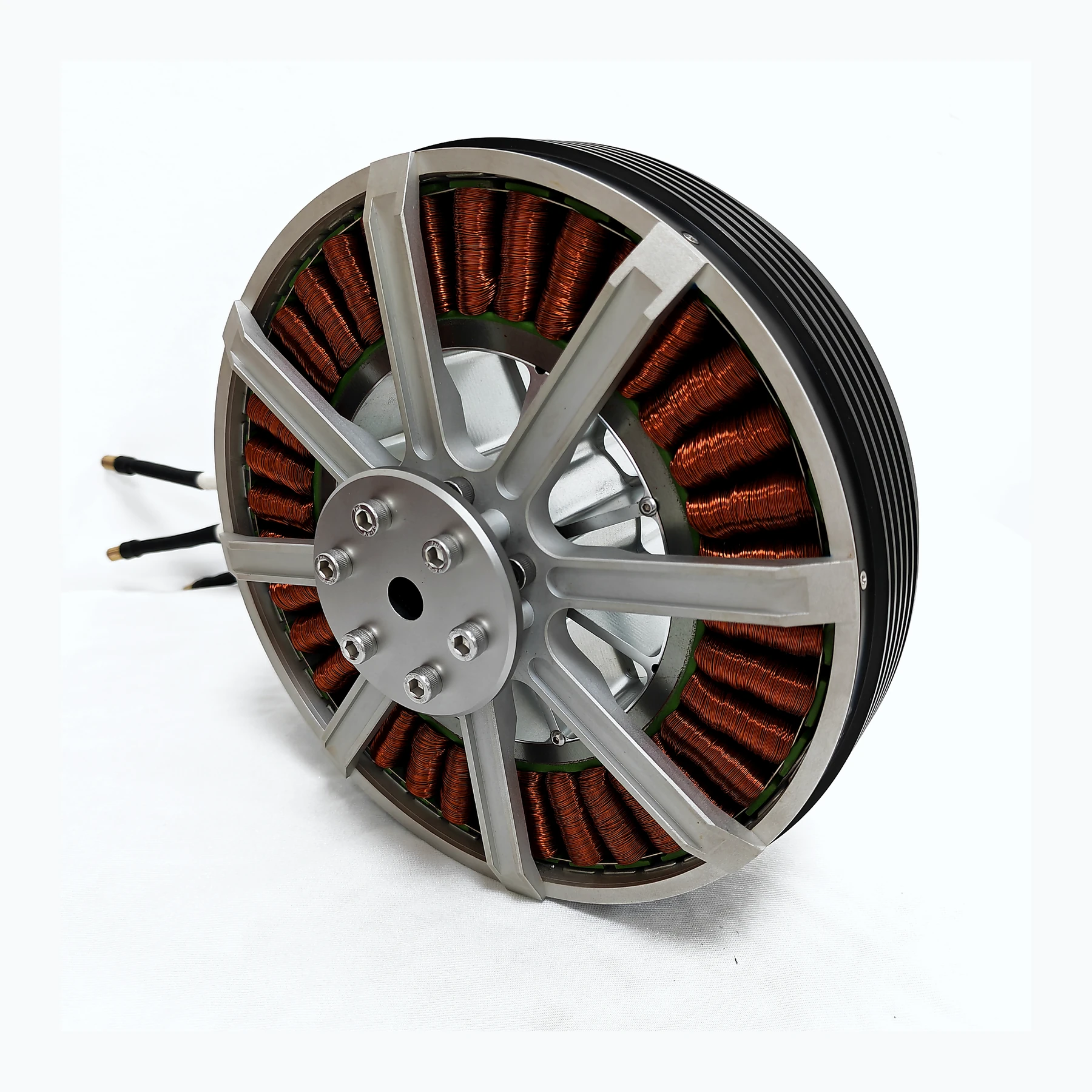
Putting rotor area into the overall airframe design
Increasing rotor disc area can change the induced power requirement, but real efficiency is also affected by blade profile, tip speed, profile drag and operating RPM. Larger propellers also increase structural dimensions and inertia, which places demands on arm spacing, mounting stiffness and control response. So "larger propellers are always more efficient" is not a conclusion you can simply buy into.
Increasing propeller diameter may reduce disc loading, but it also increases rotational inertia and the difficulty of controlling tip speed. Structural deformation, spacing between adjacent rotors, and dynamic loads in flight will limit the theoretical gains. For platforms that must pass through narrow spaces, a compact layout may matter more; for long-endurance station-keeping missions in open areas, a larger rotor area may be worth the transport cost. Understanding these differences shows why industrial UAV power layouts are increasingly segmented around applications.
At the same thrust, a larger propeller may allow a lower RPM; if mounting spacing is insufficient and the blade tips come close to structural components, local airflow interference and vibration may cancel out the gains. Transport and folding structures should also be considered, to avoid a configuration that works on the test bench but cannot be reliably assembled on the complete aircraft.
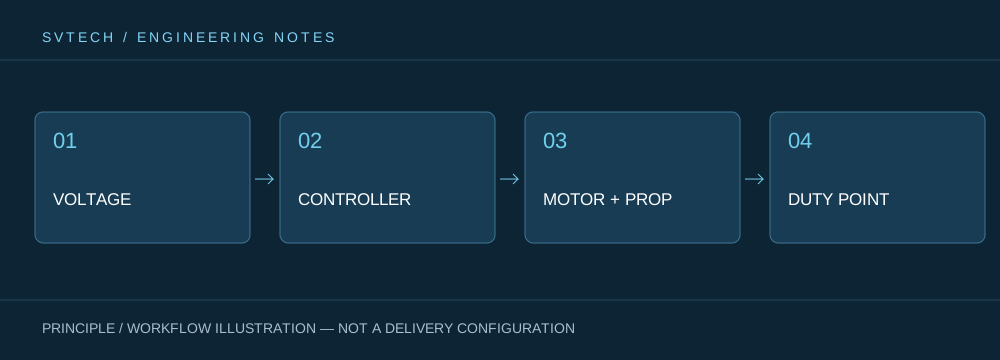
Technical principles and engineering limits
A UAV motor is not an isolated actuator. Battery, ESC, windings, propeller and airframe together determine how electrical energy is converted into lift and attitude control forces. When discussing "Large Diameter, Low RPM: A Key Path to Higher UAV Hover Efficiency", the continuous operating point, short-term peak, heat dissipation path and mounting loads should be viewed on the same mission curve: no-load RPM, maximum current or thrust alone can describe only one facet. For industrial UAV power systems, reliably completing inspection, transport or hover missions is usually more important than an extreme figure from a single bench test.
Application scenarios and implementation paths
In applications such as surveying, inspection, logistics and tethered platforms, power requirements change with payload, flight phase and ambient temperature. Engineering teams can first define the target thrust, the usual cruise or hover range and the allowable temperature rise, then check whether the supply voltage, KV, propeller and control strategy match. This kind of UAV power selection process also preserves clear technical limits for subsequent spare parts, maintenance and upgrades.
Project verification and continuous optimization
To make this technical discussion of "Large Diameter, Low RPM: A Key Path to Higher UAV Hover Efficiency" applicable to real projects, the verification phase should record configuration version, environmental conditions, measurement locations and mission results together. Compare grams-force per watt or newtons per watt under the same environment, and state the units; check blade tip clearance and arm deformation; verify acceleration and deceleration response. Only use propeller diameter ranges that have been verified through assembly and payload testing. This information is not supplementary documentation, but the shared basis for interpreting results, reproducing performance and continuously optimizing.
Related support from SV Tech
Zhuhai SV Tech Co. Ltd. (SVTECH) provides product documentation, project requirement communication and configuration limit verification for UAV motors and related industry applications. For topics such as "Large Diameter, Low RPM: A Key Path to Higher UAV Hover Efficiency", you can describe the mission operating conditions, target outcomes, site environment and existing equipment together, and Mr. Liu (+86 18688194199, lhc1983@gmail.com) will assist with the connection; specific models, performance and delivery scope are subject to confirmed documentation and project verification.
A larger propeller diameter may also change the stowed dimensions after shutdown, the personnel safety distance and ground takeoff and landing conditions. During design review, an outline envelope diagram can be used to show the swept area and structural deflection space, for joint confirmation by structural and control personnel. "It fits" should cover dynamic deformation and maintenance actions, not just the absence of intersections in a static model.
A large propeller is a design resource, not a universal answer. Only by combining it with low-RPM operating capability, airframe dimensions and the mission environment can aerodynamic potential become repeatable endurance gains.
