
When selecting a brushless motor, KV is often the most eye-catching figure, and also the easiest to misinterpret. It describes the relationship between speed and voltage, yet on its own it cannot answer how large a propeller it can drive or how much thrust it can deliver continuously. For industrial drones, choosing a motor is more like finding the right gear ratio for a mission: it must meet response requirements while keeping the commonly used operating range at reasonable efficiency.
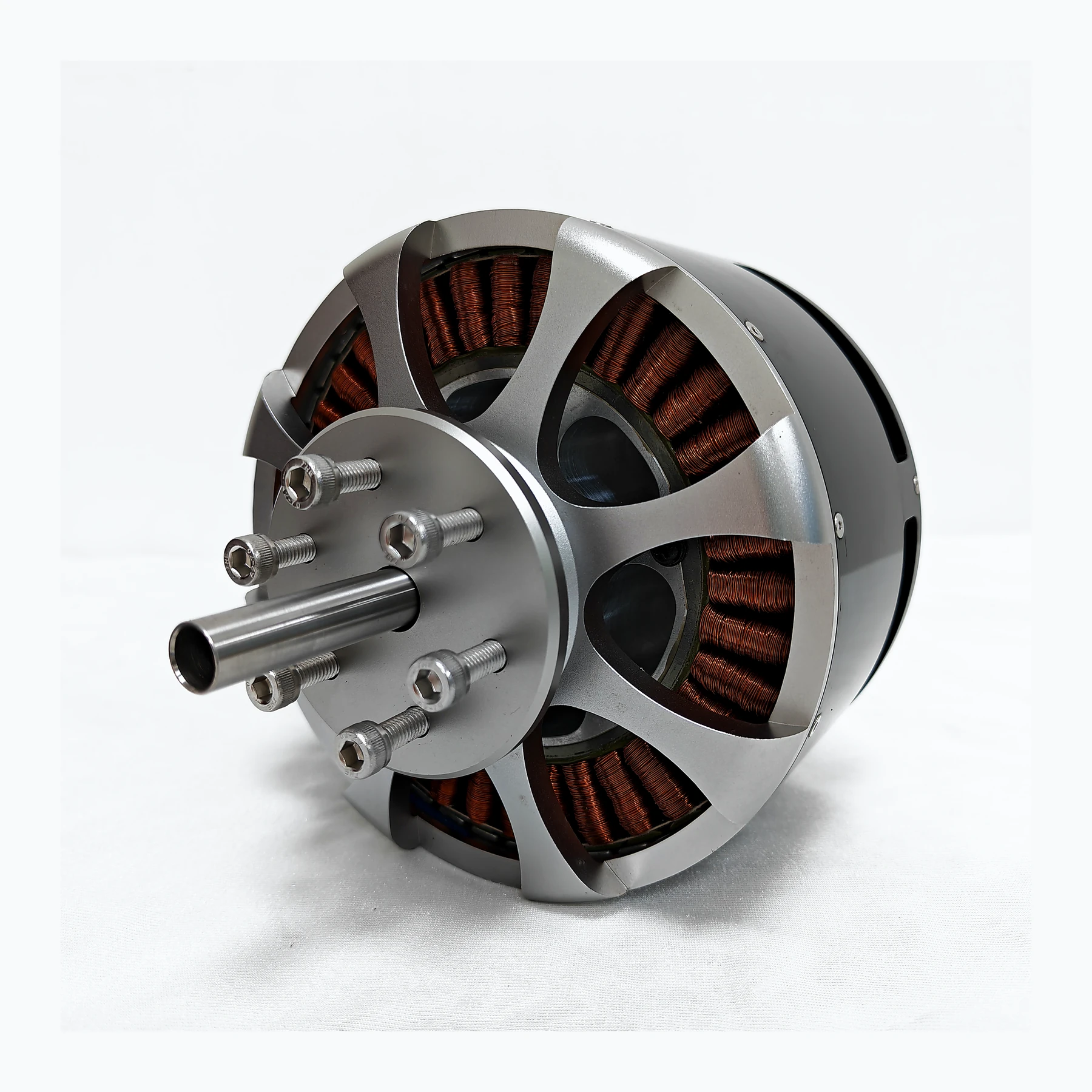
The system choices behind the speed constant
The KV of a common brushless motor is expressed in rpm/V, indicating an idealized relationship between speed and voltage; it is not kilovolts, nor is it a measure of power. Motors with the same KV may have completely different winding resistance, heat dissipation conditions and continuous torque. Mistaking a large KV for strong power easily leads to choosing a combination with sufficient speed but unsuitable temperature rise.
Lower-KV windings usually need to be discussed together with higher voltage or different propeller combinations, and cannot be compared in isolation from resistance, temperature rise and structural dimensions. In missions with a high hover proportion, the focus is on current and input power near the target thrust; when rapid attitude adjustment is required, torque response and moment of inertia also matter. Different windings in the same housing may therefore serve different missions rather than simply forming high and low tiers. Understanding this helps avoid misreading a no-load speed table as a power ranking.
A rough estimate of no-load speed can use n≈KV×U, but operation with a propeller is also affected by voltage drop, control method and load. Choosing a lower KV and increasing voltage does not automatically improve efficiency; actual input power should be compared at the same target thrust, not two no-load nameplates.
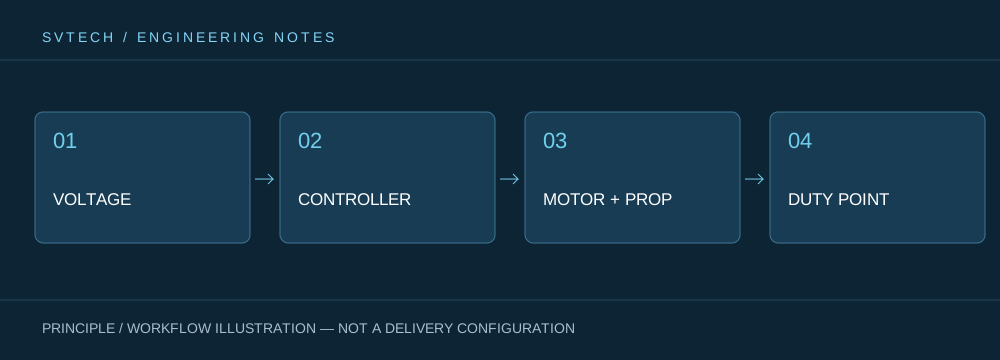
Technical Principles and Engineering Boundaries
A drone motor is not an isolated actuator. Battery, ESC, winding, propeller and frame together determine how electrical energy is converted into lift and attitude control force. When discussing "Understanding KV: The Art of Matching Brushless Motor Speed, Torque and Propellers", continuous operating point, short-term peak, heat dissipation path and mounting loads should be viewed on the same mission curve: no-load speed, maximum current or single-item thrust can each describe only one aspect. For industrial drone propulsion systems, reliably completing inspection, transport or hover missions is usually more important than an extreme figure in a single bench test.
Application Scenarios and Implementation Paths
In applications such as surveying, inspection, logistics, and tethered platforms, power requirements change with payload, flight phase, and ambient temperature. Engineering teams can first determine the target thrust, the common cruise or hover range, and the allowable temperature rise, then review whether the supply voltage, KV, propeller, and control strategy match. This drone power selection process can also preserve clear technical boundaries for subsequent spare parts, maintenance, and upgrades.
Project Validation and Continuous Optimization
To ground this technical discussion of "Understanding KV: The Art of Matching Brushless Motor Speed, Torque and Propellers" in real projects, the verification stage should record configuration version, environmental conditions, measurement locations and mission results together. Request performance tables from the supplier for the specified voltage, propeller and controller. Mark the target operating point in the table, then check current and temperature. Without continuous operating-condition records, do not derive usable output from no-load speed. This information is not supplementary documentation but the shared basis for interpreting results, reproducing performance and continuous optimization.
Related Support from SVTECH
SVTECH provides product documentation, project requirement communication and configuration boundary verification for drone motors and related industry applications. For topics such as "Understanding KV: The Art of Matching Brushless Motor Speed, Torque and Propellers", mission operating conditions, target outcomes, site environment and existing equipment can be described together, with Mr. Liu (+86 18688194199, lhc1983@gmail.com) assisting with coordination; specific models, performance and delivery scope are subject to confirmed documentation and project verification.
For example, for projects requiring low-speed drive of larger propellers, available torque and heat dissipation requirements should also be asked about. Simply replacing the original motor with a lower-KV one while keeping the original ESC and parameters is not acceptable. A procurement comparison table can treat KV as a speed-matching item and input power and temperature rise at target thrust as a working-capability item, scoring the two separately to avoid one number replacing all judgment.
The most valuable moment to discuss KV is after the propeller, power supply and mission weight have been clearly defined. Bring the parameters back to the actual operating point, and motor selection shifts from chasing numbers to explaining trade-offs, making it easier to see which scenarios each propulsion solution is best suited to.
