
The power demand of an industrial UAV is rarely a flat line. Takeoff, climb, hover, and maneuvering have different rhythms, and even with similar average power they can produce different temperature rises. Understanding the duty cycle explains why one power system may suit continuous observation but not frequent heavy-duty takeoffs and landings; the rhythm of the task itself is a design input.
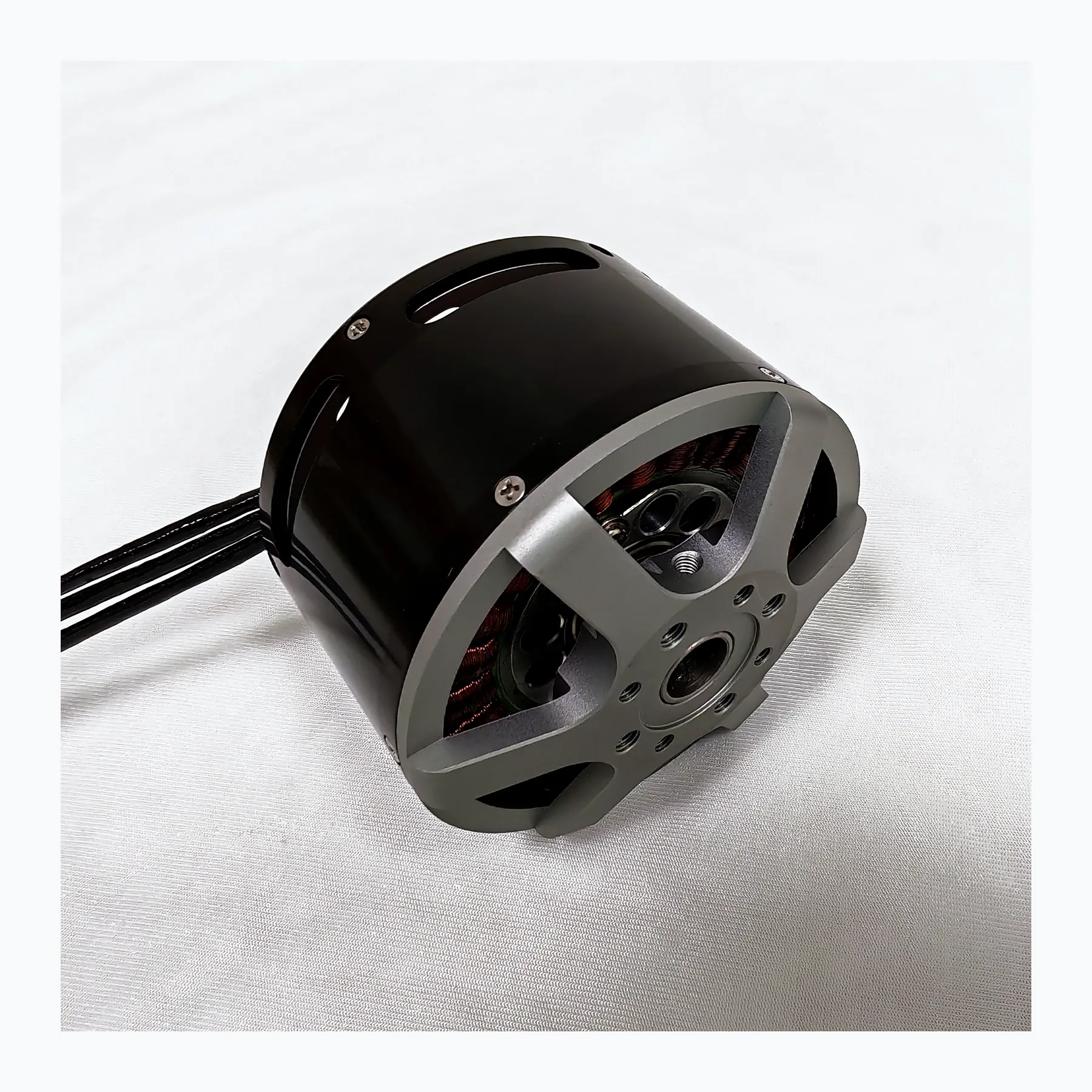
Peaks, duration, and recovery work together
Copper loss is proportional to the square of current, so using average current to estimate heating underestimates the effect of repeated peaks. Heat dissipation also takes time, so short high loads with sufficiently long cooling intervals are not equivalent to continuous moderate loads. A duty cycle should preserve how the load varies over time rather than just reporting an average power.
Winding loss does not have a simple linear relationship with current changes; short-term high loads can be harsher than what the average figure suggests. At the same time, whether the low-load phases are long enough also affects whether heat can be released. When analyzing, you can divide the task into several stages and observe the duration and heat accumulation of each stage. Such a description is closer to actual operation than a single rated power, and it is easier to compare different control and task arrangements.
In an ideal example, with 40 A for half the time and 0 A for the other half, the average current is 20 A, but the RMS current is about 28.3 A. If the resistance is the same, the copper loss is not equivalent to a continuous 20 A. A real system must also include no-load losses and temperature changes.
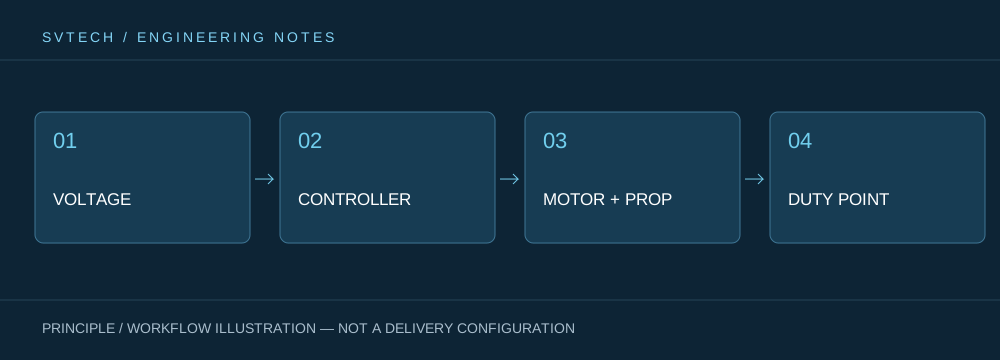
Technical principles and engineering boundaries
A drone motor is not an isolated actuator. The battery, ESC, windings, propeller, and frame together determine how electrical energy is converted into lift and attitude control force. When discussing "Same Average Power, Different Results: Understanding the Duty Cycle of a Motor", the continuous operating point, short-term peaks, heat-dissipation paths, and installation loads should be viewed on the same mission curve: no-load speed, maximum current, or single thrust each describe only one aspect. For industrial UAV power systems, reliably completing inspection, transport, or hovering missions is usually more important than the extreme numbers from a single bench test.
Application scenarios and implementation paths
In applications such as surveying, inspection, logistics, and tethered platforms, power requirements change with payload, flight phase, and ambient temperature. The engineering team can first determine the target thrust, the usual cruise or hover range, and the allowable temperature rise, then check whether the supply voltage, KV, propeller, and control strategy match. This UAV power selection process also leaves clear technical boundaries for subsequent spare parts, maintenance, and upgrades.
Project validation and continuous optimization
To ground this technical discussion on "Same Average Power, Different Results: Understanding the Duty Cycle of a Motor" in real projects, the validation phase should record the configuration version, environmental conditions, measurement locations, and mission results together. Record the peak, duration, repetition interval, and number of cycles per day. Use a representative mission cycle for temperature-rise tests, and confirm whether cooling is needed after shutdown. Write peak capability and continuous capability separately in the specifications. This information is not supplementary documentation, but the common basis for interpreting results, reproducing performance, and continuous optimization.
Related support from SV Tech
Zhuhai SV Tech Co. Ltd. provides product documentation, project requirement discussions, and configuration boundary checks for drone motors and related industry applications. For topics such as "Same Average Power, Different Results: Understanding the Duty Cycle of a Motor", you can state the mission conditions, target outcomes, site environment, and existing equipment together, and Mr. Liu (+86 18688194199, lhc1983@gmail.com) will assist with coordination; specific models, performance, and delivery scope are subject to confirmed documentation and project validation.
Dividing the task into four segments—start, acceleration, steady load, and dwell—and recording the duration and current of each is more valuable than just reporting average power. Repeated high-current pulses cause significant copper loss, and brief stops may not allow enough heat dissipation. Even if two tasks have similar total energy consumption, the maximum temperature and temperature accumulation trend must still be verified separately.
Optimizing power does not always mean replacing hardware. Adjusting takeoff and landing frequency, load distribution, or task rhythm can sometimes allow an existing system to operate more comfortably; provided these changes are validated under actual operating conditions.
