
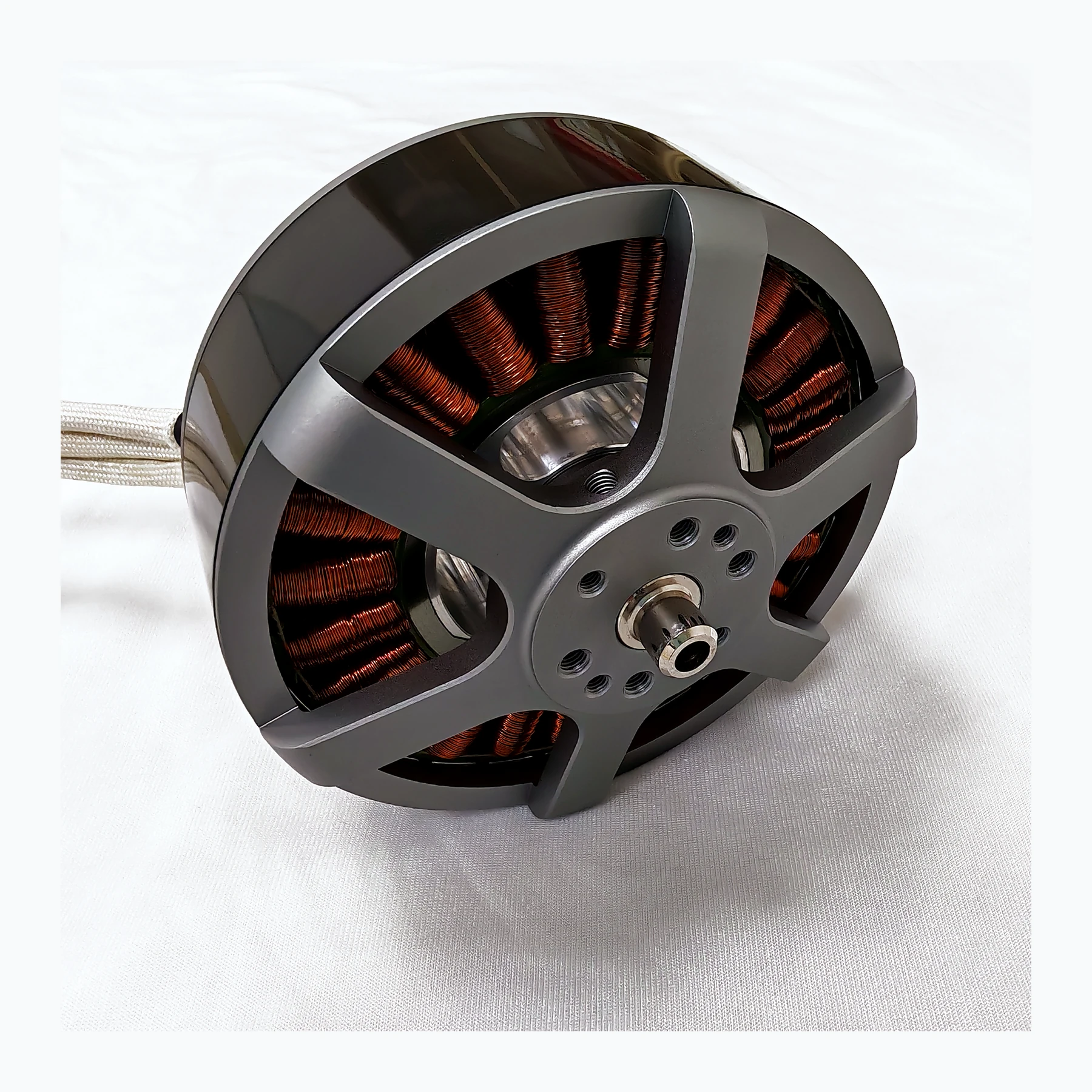
Convert the mission into rotor loads
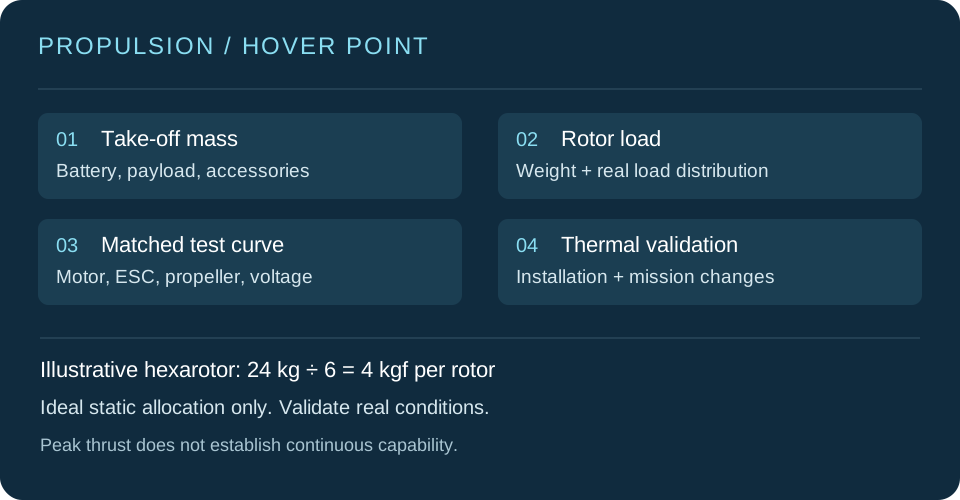
For an approximately level multirotor with an even load distribution, total hover thrust balances aircraft weight. An illustrative six-rotor aircraft with a total mass of 24 kg needs an average of about 4 kgf, or 39.2 N, per rotor. This is an ideal static allocation. Centre of gravity, airframe interference, attitude changes and environmental conditions affect the real distribution. A tethered platform must also account for the suspended cable and its forces. Use take-off mass including batteries, payload, mounts and operating accessories, not empty-airframe mass.
Locate the operating point in matching test data
With the target thrust established, examine measured data for the actual motor, ESC, voltage and propeller combination. Points measured with different propeller sizes, pitches, voltages or controller settings cannot simply be combined into one curve. Record current, input power and speed near the required thrust, together with test conditions and duration. Avoid extrapolating beyond the measured range. For a specific model such as the A32 motor, check the combination in the current datasheet. The 24 kg example here is not a recommended aircraft load for the A32.
Separate peak output from thermal capability
Reaching a thrust value briefly does not establish that the winding, ESC, connectors and supply can sustain it. Copper losses depend on current, while cooling depends on installation, propeller airflow, ambient temperature and component spacing. Increase load progressively in an installation representative of the aircraft, observe whether temperatures approach a steady condition and set stop criteria using each component's limits. Surface temperature is not the winding hot-spot temperature. Document sensor location, attachment and logging interval so results from different runs can be interpreted consistently.
Also distinguish battery-side DC-bus current from motor phase current; they are measured at different points and are not interchangeable. Confirm whether an ESC reports peak, average or RMS current. If instruments disagree, check sensors, sampling and definitions before concluding that a limit was exceeded. Align current with simultaneous voltage, thrust and temperature records to distinguish load changes, supply effects and measurement differences.
Compare total input power at the hover point
At the same required thrust, lower input power generally reduces energy consumption. Compare complete propulsion combinations rather than motor names or KV ratings alone. Falling battery voltage changes the operating point, and wiring and ESC losses also matter. If using a thrust-to-power ratio, state its units, thrust point and measurement boundary; the best figures obtained at different loads are not a fair comparison. Larger propellers are not automatically better: rotor spacing, interference, structural loading and attitude response constrain the usable combinations.
Validate reserve capability against the mission
Gusts, climbing, turning and load changes require control capability beyond steady hover. Define reserve from the flight envelope and aircraft validation rather than treating a single multiplier as a universal safety rule. Check normal hover, representative dynamic conditions and the supply state near the end of the mission separately. Long inspection, communications-relay and fixed-point observation missions also require attention to payload demand and cooling changes. A combination that runs continuously on a bench still needs aircraft-level checks for vibration, fasteners, wiring temperature and control response.
Build a decision-ready propulsion record
Keep take-off mass and centre of gravity, rotor count, required thrust range, supply range, motor and ESC versions, propeller specification, temperature measurement points, run history and anomalies together. Service-life statements also depend on their stated conditions: a short thrust test cannot demonstrate an upper service-life claim, and that claim should not be transferred to an unverified model. Zhuhai SV Tech Co. Ltd. can help check propulsion combinations and interfaces against current motor documentation. Defining the normal operating point and mission variations gives a stronger basis for selection than choosing the highest peak-thrust figure.
Business enquiries: Mr Liu, +86 18688194199, lhc1983@gmail.com.
