
Mounting two rotors on the same axis allows more power units to be packaged within a limited footprint, which is why coaxial configurations attract attention for heavy-lift platforms. But the air shared by the upper and lower rotors is not still, and the space advantage of a compact layout comes with aerodynamic interference. Only by understanding this set of trade-offs can the real mission value of a coaxial design be assessed.
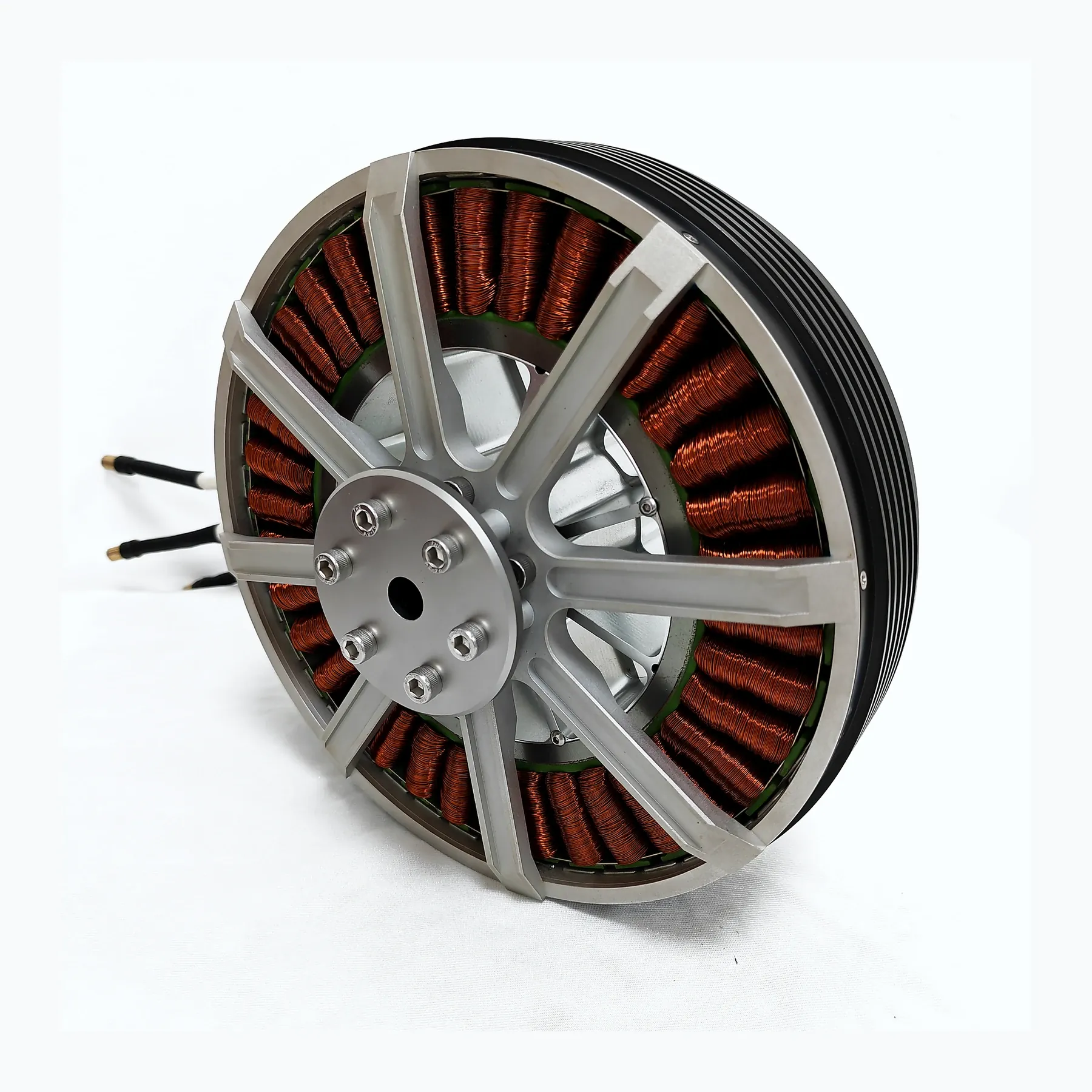
The upper and lower rotors are not two independently operating power sets
The upper and lower rotors share a flow field, so spacing, rotation direction and thrust distribution all affect interference losses. A coaxial layout is compact, but single-rotor bench data cannot fully describe the combined performance, and vibration of the blades caused by airflow and structural effects must also be considered.
The upper rotor alters the inflow to the lower one, so the load and efficiency of the lower rotor may differ. Spacing, rotation direction, blade design and control allocation jointly affect the result, and single-rotor bench thrust values cannot simply be added together. For projects sensitive to transport and deployment space, a coaxial design may be worth adopting, but the decision should be based on power consumption and response measured for the complete layout.
When comparing two spacings, holding total thrust fixed and measuring total input power is more meaningful than holding both motor throttles fixed. Also check whether the currents of the upper and lower motors are unbalanced, so that normal total power does not mask overheating of an individual unit.
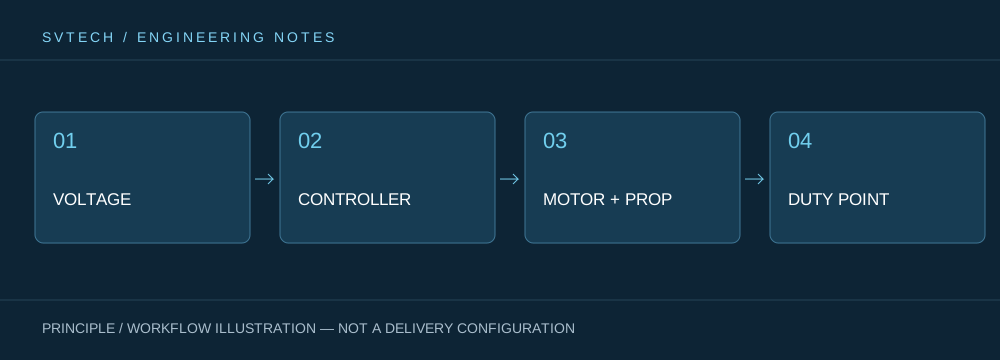
Technical principles and engineering boundaries
A drone motor is not an isolated actuator. Battery, ESC, windings, propeller and frame together determine how electrical energy is converted into lift and attitude control force. When discussing "The compact approach of coaxial multirotors: balancing space, airflow and efficiency", the continuous operating point, short-term peak, heat dissipation path and mounting loads should be viewed on the same mission curve: no-load speed, maximum current or a single thrust figure each describe only one facet. For industrial UAV propulsion systems, reliably completing inspection, transport or hover missions is usually more important than an extreme figure from a single bench test.
Application scenarios and implementation path
In applications such as surveying, inspection, logistics and tethered platforms, propulsion requirements change with payload, flight phase and ambient temperature. Engineering teams can first define the target thrust, the usual cruise or hover range and the permissible temperature rise, then check whether the supply voltage, KV, blades and control strategy match. This UAV propulsion selection process also leaves clear technical boundaries for subsequent spare parts, maintenance and upgrades.
Project validation and continuous optimization
For this technical discussion on "The compact approach of coaxial multirotors: balancing space, airflow and efficiency" to translate into real projects, the validation phase should record the configuration version, environmental conditions, measurement locations and mission results together. Record spacing, blade type, rotation direction and the respective operating points; verify the temperature rise and control response of the complete assembly. Without combined testing, report the data as single-motor results and do not promise coaxial efficiency. This information is not supplementary documentation but the shared basis for interpreting results, reproducing performance and continuously optimizing.
Related support from SV Tech
Zhuhai SV Tech Co. Ltd. provides product documentation, project requirement discussions and configuration boundary checks for drone motors and related industry applications. For topics such as "The compact approach of coaxial multirotors: balancing space, airflow and efficiency", describe the mission conditions, target outcomes, site environment and existing equipment together, and Mr. Liu (+86 18688194199, lhc1983@gmail.com) will help with the coordination; specific models, performance and delivery scope are subject to confirmed documentation and project validation.
Coaxial comparisons should record the rotation direction of the upper and lower propellers, blade type, distance and support structure. Simply adding the two thrust values from single-motor bench tests is usually insufficient to describe the combined effect. The thermal environment and control allocation of the upper and lower power units must also be considered; evaluating a project with complete assembly data makes it easier to identify airflow interference and uneven local loading.
Compactness and high efficiency do not always point the same way. The point of a coaxial design is to trade an explainable efficiency cost for a suitable airframe size, and to make that trade serve the actual operational requirement.
